2025 Annual Results: Financial Review

Stephan Jansma
Chief Financial Officer

Trafigura delivered a resilient financial performance in FY2025, successfully navigating a challenging operating environment. Net profit for the year was USD2,666 million, down just three percent from FY2024.
The Group’s ability to generate strong returns in markets without clear directional trends, and amid persistent short-term volatility, underscores the resilience of our business model and the core service that we perform in the value chain.
Performance was good across our main trading divisions. This was reflected in our underlying earnings before interest, tax, depreciation and amortisation (EBITDA), which exceeded USD8.0 billion for the fourth consecutive year. Of significance this year, was the strong performance of our metals trading business.
While our underlying trading performance remained robust, net profit was affected by impairment charges recorded against certain assets. Notably, on fixed assets, in addition to Nyrstar Australia’s smelters and Greenergy's Immingham facility, we recognised impairments on our Myra Falls mining operations and Puma Energy's bitumen business.

Overall, the establishment of our Operating Assets division has strengthened governance and oversight across our portfolio of fixed-asset investments in oil, metals, gas, power, and renewables. This reflects the management team’s determination to take a more proactive approach to overseeing and optimising our fixed asset investments, while also adopting a more disciplined and strategic approach to investments.
Other highlights of FY2025 included our successful return to the public debt capital markets, with a USD500 million five-year public bond issuance, and completion of the Group’s largest ever transaction of USD390 million in the US Private Placement market, including an inaugural 12-year tranche.
The success of these transactions shows the confidence that the banking market and institutional investors have in Trafigura’s creditworthiness, built on open engagement and reporting, and three decades of reliable performance in global commodity markets.
With regards to the previously disclosed serious misconduct by individuals in our Mongolian oil business, the review remains ongoing. We have continued to implement a series of actions to improve our processes, controls and oversight. This remains a key focus for our Board of Directors and Executive Committee.
Over the period, revenue was relatively stable at USD240,268 million, down one percent versus a year earlier, as lower average commodity prices were largely offset by higher oil trading volumes.
At 358 million metric tonnes in FY2025, or an average of 7.6 million barrels per day, total traded volumes of oil and petroleum products, including natural gas and LNG, were around 10 percent above the previous year’s level.
Non-ferrous metals volumes decreased by 11 percent and bulk mineral volumes by 17 percent respectively as we prioritised profitable flows.
Total assets increased by four percent in FY2025 to USD79,494 million, as higher inventories and trade receivables were largely offset by lower right‑of‑use assets and cash and cash equivalents. Group equity stood at USD16,172 million at the end of September 2025, representing more than 20 percent of total assets.
Once again, we were able to keep our financial leverage significantly below our medium-term target, with the ratio of adjusted debt to Group equity standing at minus 0.40, in line with previous year.
This solid financial position ensures that we are well equipped to navigate the complex commodity markets of a more fragmented world, while maintaining the flexibility to pursue strategic investments that enhance our core business.
Turning to divisional performance, our energy segment, which includes Oil and Petroleum Products, Gas, Power and Renewables, associated freight and operating assets, delivered a good result despite unpredictable market conditions. It generated revenue of USD166,980 million (representing 70 percent of total Group revenue) and an operating profit before depreciation and amortisation of USD6,091 million, slightly down from USD6,229 million in the previous year.
Our Metals and Minerals segment, which includes bulk commodities, associated freight and operating assets, generated revenue of USD73,288 million (representing 30 percent of total Group revenue) and an operating profit before depreciation and amortisation of USD2,016 million, up from USD1,963 million.
A strong performance from our non-ferrous metals business was a key driver of this result and reflects our ability to capitalise on opportunities arising from evolving global trade patterns and a strong network of long-term customer relationships.
Financial statements
Group net profit for the year was USD2,666 million, down three percent against USD2,759 million in FY2024. Underlying EBITDA was roughly stable at USD8,165 million, compared to USD8,233 million in the prior year period, driven by the strong performance of our three key trading divisions. Cost of materials, transport and storage at USD228,239 million was marginally lower year-on-year, while employee benefits were USD2,043 million up from USD1,578 million, mainly reflecting the acquisition of Greenergy.
Impairments of fixed and financial assets of USD843 million were lower than USD1,074 million in FY2024. During the year, the Group recognised fixed asset impairment charges totalling USD340.5 million, in relation to Nyrstar Australia, Myra Falls mining, Greenergy’s closure of its Immingham plant and a number of other assets.
The result from equity-accounted investees and other investments was a profit of USD50 million, flat year‑on‑year. Net financing costs of USD1,217 million in FY2025 were nine percent lower than in FY2024.
Total non-current assets were USD16,843 million, slightly down from USD17,311 million, in part due to the reduction of right-of-use assets in our shipping business.
Total current assets were USD62,365 million, up from USD59,045 million, reflecting increased traded and stock volumes at the end of FY2025, resulting in higher receivables and inventories. Cash and cash equivalents including short-term deposits stood at USD7,916 million, down from USD11,266 million at the end of FY2024, resulting from an increased focus on unfunded liquidity.
In terms of cash flow, operating cash flows before working capital charges were USD8,235 million, compared to USD8,283 million in FY2024. We believe operating cash flow before working capital is the most reliable measure of our financial performance, because the level of working capital is predominantly driven by prevailing commodity prices and is funded through the Group's self-liquidating financing lines.
Investing activities resulted in a net cash use of USD1,757 million, versus USD1,384 million in FY2024, primarily reflecting maintenance capex for our existing fixed asset investment portfolio and Trafigura’s strategic investments in the Fos-sur-Mer refinery and Cogentrix Energy.
Net cash used in financing activities was an outflow of USD5,365 million, from an outflow of USD8,887 million in the prior year, reflecting greater use of shareholder funds in financing working capital requirements. During the period the Group paid dividends of USD2,911 million, compared to USD2,016 million in FY2024. In accordance with our dividend policy, the Board can announce and instruct distribution of dividends, subject to maintaining the Group's liquidity, equity and financial leverage at an adequate level.
Liquidity and financing
The Group continued to maintain strong access to credit lines throughout the year, ensuring an ample liquidity buffer. As at 30 September 2025, the Group had immediate (same day) access to available cash in liquidity funds and unutilised committed corporate credit facilities of USD14.6 billion, in line with the previous year. Overall, our access to funding and liquidity underpins the Group’s resilience to any future market volatility, disruptions or higher prices in the future.
Most of our day-to-day trading activity is financed through uncommitted, self-liquidating trade finance facilities, while we use corporate credit facilities to finance other short- and medium-term liquidity requirements, such as margin calls or bridge financing. This funding model gives us the necessary flexibility to cope with periods of enhanced price volatility. We also maintain an active debt capital markets presence to secure longer-term finance in support of our investments as per an asset-and-liability duration management policy.
During the 12 months ended 30 September 2025, the Group secured several important financing transactions.
In October 2024, we refinanced our Asian syndicated revolving credit facility (RCF) and term-loan facilities (TLF) at USD3.2 billion-equivalent, with 38 banks participating, including five new lenders.
In January 2025, we announced the closing of an inaugural uncommitted discounted facility of credit-insured receivables and prepayments totalling USD1.0 billion. The facility was substantially oversubscribed and upsized from its initial launch amount of USD800 million, with seven financial institutions participating in the transaction.
Also in January 2025, we issued a RMB1.5 billion bond (USD205 million-equivalent) with a tenor of three years in China’s domestic debt market (Panda bond). This marked the Group’s successful return to the Panda bond market for the first time since 2021, supported by strong demand from Chinese and international RMB investors, including commercial banks, asset managers and securities firms.
In February 2025, we signed a USD235 million loan agreement co-funded by Abu Dhabi Exports Office (ADEX) and two banks. The agreement will support Trafigura’s procurement of commodities originating from the UAE.
Further in February 2025, we renewed a three-year USD300 million loan facility with the Export-Import Bank of Korea (KEXIM). The facility will support Trafigura to provide a stable supply of critical metals to customers in South Korea.
In March 2025, we refinanced our flagship 365‑day European multi-currency syndicated RCF totalling USD1.9 billion, while extending and increasing our USD3.7 billion three‑year RCF. The flagship facility was increased by USD70 million, bringing its total size to USD5.6 billion.
In May 2025, we closed our largest to date USD390 million US Private Placement (USPP) across five-, seven-, ten- and twelve-year tenors. The transaction represents Trafigura's eighth issuance in the US private placement market, where we now have over USD1 billion of notes outstanding.
In July 2025, we issued a USD500 million senior RegS bond with a five-year maturity under our Euro Medium Term Note (EMTN) programme. This transaction marks our successful return to the public debt capital markets. The proceeds from the issuance were used for general corporate purposes, notably to refinance a USD500 million bond that matured in September 2025.
Also, in July 2025 Trafigura closed a USD200 million facility guaranteed by the Korea Trade Insurance Corporation (K-SURE), the Korean Export Credit Agency (ECA). The agreement is the first time that an ECA has offered mid- to long-term financial support based on time charter vessel agreements.
In August and September 2025, we renewed two revolving credit facilities for a total amount of USD400 million, with insurance from the Export‑Import of the United States (US EXIM). We will use the facilities exclusively to purchase energy products from US producers for export to Europe and other key markets in Asia and South America.
Finally, after the financial year end, in October 2025, we refinanced our Asian RCF and TLFs at USD3.4 billion equivalent, with 43 banks, including six new lenders. The new facilities comprised a 365-day USD RCF (USD1.1 billion), a one-year CNH TLF (c. USD1.1 billion-equivalent) and a three‑year USD TLF (USD1.2 billion). This represented close to USD800 million in additional liquidity for the Group, mostly in the three-year tranche.

Taxation
We operate in multiple jurisdictions and adhere to applicable local and international tax laws, including legislation on transfer pricing, in those countries in which we operate. The Group's tax policy is to pay appropriate tax according to work carried out in each jurisdiction, as determined by a functional analysis of operations using standard measures wherever possible, which is underpinned by reports prepared to fulfil local transfer pricing requirements.
In FY2025, our effective tax rate – the average rate at which consolidated pre-tax profits are taxed – was 12 percent (or USD346.2 million), in line with historical averages.
Outlook
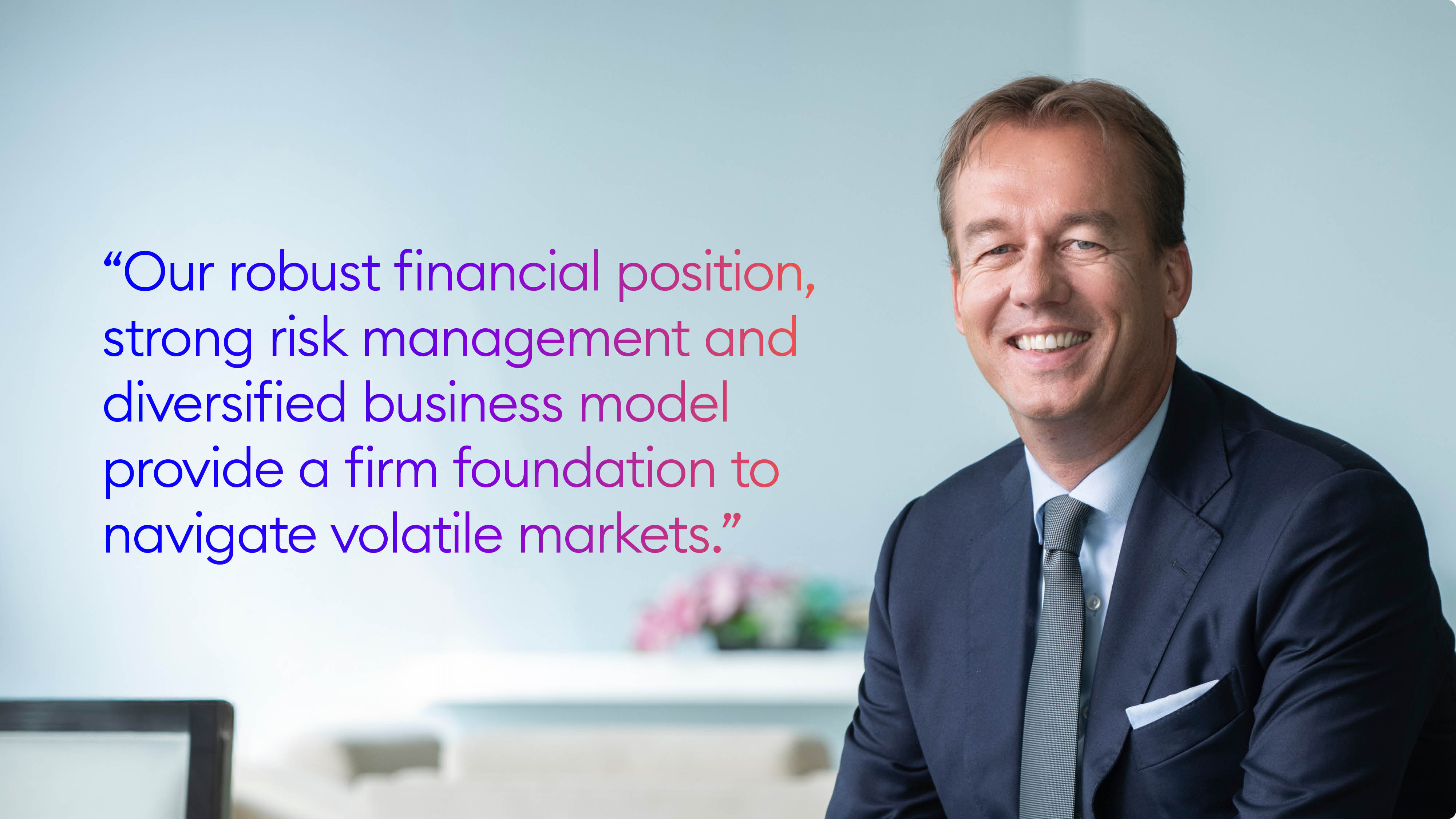
Looking ahead, we expect market conditions to remain complex and uncertain, with volatility likely to persist as new trade patterns evolve. However, our robust financial position, strong risk management, and diversified business model provide a firm foundation to navigate this ‘new normal’.
We will continue to adapt our strategies and invest selectively to strengthen our core activities, and to leverage opportunities arising from structural shifts in global commodity flows and markets.