2026 Half Year Report: Marketplace review

Saad Rahim
Chief Economist
After the tumult of the past few years, FY2026 looked like it would be a more sedate period for commodity markets. Having navigated the tariff war, the global economy looked set for a steady if unspectacular recovery, driven mainly by AI‑related spending. Oil markets in particular faced a major supply overhang, providing an additional tailwind to global growth, especially in emerging economies. Metals were buoyed by the prospect of continued demand growth, while concentrates availability remained limited for both copper and zinc, supporting prices.
But that was all before the conflict in the Middle East. The outbreak of hostilities between the US and Iran has thrown global commodity markets into turmoil. As of this report, shipping volumes through the Strait of Hormuz remain close to zero due to the threat of attacks on vessels. Oil production, both crude and refined products, remains significantly curtailed.
In our estimation, daily losses amount to approximately 14 million barrels per day compared to pre-conflict levels. That number accounts for the various bypass routes and pipelines that are being utilised, without which the loss would be over 20 million barrels per day. The losses mean the world has already lost more than 1.1 billion barrels of oil. Gas production has also been impacted to a similar degree, as Qatar produces about 20 percent of the world’s LNG and has also been unable to produce or export at normal levels.
As a result, global energy prices have risen sharply during the conflict. Crude oil (Brent) and diesel prices are 60 percent higher, gasoline (retail) prices are over 50 percent higher, and jet fuel prices are over 70 percent higher. Natural gas prices in Europe are also about 60 percent higher than on the eve of the war.
Yet these increases, substantial though they may be, are less than almost all industry forecasts for a disruption of this magnitude, characterised by the IEA as the largest energy crisis in history.
A key reason for the relatively muted price response is that we entered the year with oil inventories at elevated levels, in some cases at record highs for the time of year, creating some buffer. Another reason is that physical markets always have commodities in transit, and in the case of oil markets some cargoes can be on the water for months, creating a type of floating inventory that takes time to be fully cleared. Those barrels were added to via the largest coordinated release of strategic petroleum reserves (SPRs) in history, approximately 400 million barrels in total by OECD nations, with almost half of that amount coming from the US. China has also contributed via lower refinery run rates, demand reductions, ramping up coal-to-liquids and limiting product exports. The conflict also started during the “shoulder season” between winter and summer and so fell between peak diesel demand and peak gasoline/jet fuel demand. That in turn allowed refiners to focus production on diesel and jet fuel, essentially borrowing time by drawing down gasoline inventories instead. And finally, a steady stream of headlines signalling the potential for a negotiated peace, which would bring not only the trapped barrels back online but possibly add even more in the form of Iranian ones, meant that market participants were cautious of exposure to headline risk.
All of these factors have bought the market some time, and therefore prices remain relatively contained. But we are now at an inflection point. While as of writing a peace deal looks to be announced imminently, restoring production and shipping flows to pre-conflict levels will, by most estimates, take months, not weeks. That means we will continue to be in a supply deficit. OECD commercial (non‑SPR) inventories are now starting to draw rapidly, with most breaking well below their five-year ranges already. US gasoline stocks in particular have already reached the level they normally do at the end of the year, after driving season and refinery maintenance – but before driving season has even started. Indeed, we are seeing inventories draw at a record pace now in the US, with more to come.
With a supply shock of this magnitude, there are simply not enough molecules to meet demand; therefore, demand destruction is required. Markets in the West also do not feel tight yet because there have already been significant reductions in demand across Asia, Australia and Africa. While Brent prices on the exchange are hovering just above USD100 per barrel, refined product prices are well above USD200 per barrel, and in some areas significantly more including freight and delivery. That demand destruction has freed up molecules to move to Western markets, alleviating some of the tightness there, but only temporarily.
As such, while a peace agreement is still possible in the coming weeks, physical markets are already facing serious challenges. And if the conflict were to persist alongside the restrictions to shipping flows, then these challenges will become truly historic.
The knock-on impacts on other markets have been relatively limited so far, but we are starting to get signs of stress emerging, particularly across Asian markets. Most major Asian currencies have seen significant depreciation since the crisis started, and many have hit all-time lows against the dollar. Sovereign bond yields globally have also moved much higher, many hitting their highest levels since the 2008 financial crisis, and others, especially longer tenors, hitting all-time highs. While the pressure on government bonds was already an issue prior to the conflict, thanks to persistent and ever-growing deficits, the additional costs of energy subsidies due to the conflict are materially increasing the stress.
So where does this leave us? The factors that have contained prices so far – elevated inventories, floating cargoes, coordinated SPR releases, a shoulder season, and demand destruction across Asia and Africa – have bought the market time, but are not a solution. Those buffers are now largely spent, and we are at a critical juncture.
A negotiated peace, if it materialises soon, would ease some of the pressure but restoring production and shipping flows to pre-conflict levels would still take months, meaning a supply deficit would likely persist regardless. If the conflict continues, the challenges ahead will be severe.
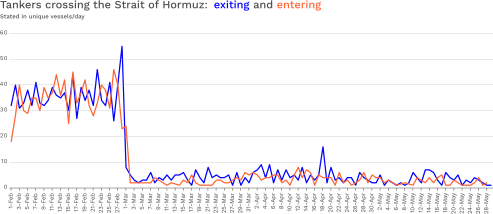
Source: AIS, Trafigura Research and Kpler